Check some paper, it seems that they are okay but cost higher by the asynchronous FIFO.
Mesochronous clocks means the TX and RX clock are only have phase shifted but they both come from the same crystall/PLL. The Plesiochronous means the both TX and RX come from different crystall/PLL but with the nearby frequences. So some resynchonaztion of the counter n the RX site to TX side is need after running for, example, 10000 clock cycles.
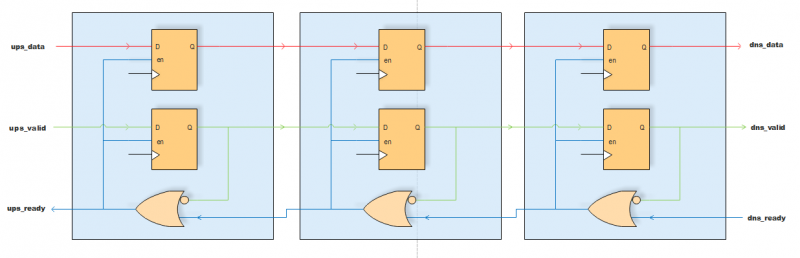
Above diagram shows the ready signal is not pipeline, which cause the timing closure issue when long dealy.
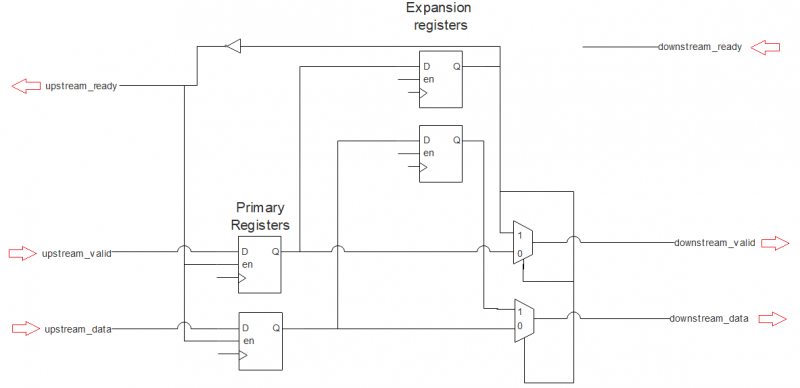
The next one shows the ready signal is pipeline. o_ready functional as current stoage has room to store the input data and when i_valid is active, data latched into r_data register. At this time, when i_ready is not active, the latched data shall go to skid register b_data.
 1 //
  2 // pipeline for the valid and ready data exchange with skid buffers
  3 //
  4 // Basically, the valid signal flags whether conresponding data are valid.
  5 // i_valid flags i_data is valid.
  6 // r_valid flags r_data is valid.
  7 // b_valid flags b_data is valid.
  8 // When b_valid is assert, put the b_data/b_valid as the priority output; otherwise, // put r_data/r_valid as output.
  9 //
 10
 11 module axi_valid_ready_pipeline #(
 12     parameter DATA_WIDTH = 8
 13     ) (
 14     input wire clk,
 15     input wire rst_n,
 16
 17     input wire i_valid,
 18     input [DATA_WIDTH-1:0] i_data,
 19     output wire o_ready,
 20
 21     output wire o_valid,
 22     output [DATA_WIDTH-1:0] o_data,
 23     input wire i_ready
 24 );
 25
 26 reg r_valid, b_valid;
 27 reg [DATA_WIDTH-1:0] r_data, b_data;
 28
 29 always @(posedge clk or negedge rst_n)
 30     if (!rst_n) begin
 31         r_valid <= 1'b1;
 32         r_data  <= 'b0;
 33         b_valid <= 1'b1;
 34         b_data  <= 'b0;
 35     end
 36     else if (o_ready) begin // accept data if o_ready is high, mean either r or b register are ready to accept data
 37         r_valid <= i_valid;
 38         r_data  <= i_data;
 39         if (!i_ready) begin // when the next stage is not ready, store r registers data into b registers
 40             b_valid <= r_valid;
 41             b_data  <= r_data;
 42         end
 43     end
 44     else if (i_ready) begin // when next stage is ready, b valid shall be clean
 45         b_valid <= 1'b0;
 46     end
 47
 48
 49 assign o_ready = ~b_valid; // when b_regiser is not taken, the o_ready set to 1.
 50 assign o_valid = b_valid ? b_valid : r_valid;
 51 assign o_data  = b_valid ? b_data  : r_data;
 52
 53
 54 endmodule
By adding the command line into the Chrome icons “–disable-dinosaur-easter-egg”. Append at the end of the target box of property tab by right clicking on the Chrome icon.
“C:/…./chome.exe” –disable-dinosaur-easter-egg
Information get from the following link, which is a long thread. Jump to Comment #59 from ” atwilson@chromium.org
to get the conclusion.

 ASIC FPGA Digital Design